



5 minutes, 3 steps: check your business in AI answers
Share
Save
Label: AI and maps
By Alex Nekrashevich, Google Product Expert since January 2019 (LinkedIn). Checked 23.11.2026: figures and Google rules as of 23.11.2026, sources at the bottom.
The information is current as of the end of November 2026. We update this article, so check back for updates.
The short answer
More and more customers in Norway ask an AI assistant for advice, and it names a few places instead of ten links. Whether your coffee bar, restaurant, dental clinic, hair salon or garage is among them, or you as a specialist (a tradesperson, doctor, lawyer, coach), takes five minutes to check and costs nothing. Three steps:
- Ask any AI assistant, as a marketer, for the five actions that would best promote a business like yours in your city (Oslo, Bergen, Trondheim). See what comes first.
- From someone else's phone or computer, ask what the internet knows about your business (or about you, if you are a specialist: your name and city), and see who the assistant recommends instead of you. Read all of it, reviews included.
- Put in order everything the assistant and your customers draw on: maps, profiles, directories, reviews, articles, forums and blogs.
Five minutes to check, a few weeks to put in order. The first two steps take five minutes. The third is a few weeks of work, but it is better to start today: the earlier you start, the easier, faster and cheaper it is. We do not promise results, because nobody outside knows exactly how AI assistants choose businesses. Below is only what you can check yourself, with figures, sources and dates.
Why maps and directories matter so much now
When you drive, you follow a navigator, not a paper map. When you walk through a city you do not know, you also trust the map, the reviews on it, the ratings and local directories. In Norway this is familiar: a visitor looks for a place to eat, a place to stay or a dentist right on the map. An AI assistant does the same: it does not want a single place, it wants several confirmations, and it gathers them from the same maps, directories and reviews.
What the research shows:
- In a BrightLocal survey (1,002 US adults, published 11 February 2026), 45% said they had used ChatGPT or another AI tool for local business recommendations in the past year, up from 6% a year earlier. AI became the third most used source of recommendations; 40% of respondents trust it and 32% do not. It is a US survey of what people say they do. We have not found equivalent public surveys for Norway, so read the figures as a direction, not a forecast for your city.
- In the same survey, 31% of consumers will only use a business rated 4.5 stars or higher (17% a year earlier), and 74% look at reviews written in the last three months. People and AI assistants both see recent reviews and ratings.
- In October 2025, Yext analysed 6.8 million source citations in answers from ChatGPT, Gemini and Perplexity (collected 1 July to 31 August 2025). 44% of citations pointed to the businesses' own websites, 42% to directories and listings, 8% to reviews and social media. For an owner the point is simple: most of what AI draws on is within your reach.
Some of your competitors already work on maps and directories. Check it yourself, that is the next step.
Step 1. Ask the assistant as a marketer (2 minutes)
Open any AI assistant: ChatGPT, Gemini, Claude or another. Type:
> You are a senior local marketing expert. Based on real promotion experience, name the 5 most effective actions to get more customers for a [small coffee shop, restaurant, hotel or guest house, dental clinic, hair salon, car repair shop, plumbing service] in [Oslo, Bergen, Trondheim]. Short list, most important first.
In my checks, the assistant almost always puts Google Maps and reviews first, that is, your Google Business Profile (your listing on Google Maps), and names local directories in second or third place. I ran this two or three times from different browsers. The remaining places vary by business and by assistant, and I do not say "always": the answer depends on the assistant, the request and the day, so ask two or three different assistants and compare. If you get something different, tell us in the comments, we are curious. If you are a specialist rather than a company, replace the business with your profession, for example "my services as a lawyer in Oslo".
Here is one dated example. ChatGPT, not signed in, a clean browser, 23 November 2026, 12:50, one request about a small coffee shop. The five actions it named: 1) Google Maps and reviews, 2) a loyalty programme, 3) local partnerships, 4) Instagram and TikTok, 5) promotions. In this answer directories did not appear, so the order of the second and third places changes from one answer to another.
The same picture from the customer's side. We also asked a customer's question, "How do I find a good coffee shop in Oslo?", on 23 November 2026. Oslo is our own city here, so the example applies to you directly if you are in Oslo; in other cities you can repeat it in five minutes with your own question. In these checks Claude (about 13:28) and ChatGPT (about 13:30) open their answer with a map and ratings, and two coffee shops, Tim Wendelboe and Supreme Roastworks, appear in both and in Google Maps (13:34). In three of five checks the assistant relied on guides and directories or advised them: Gemini (about 13:32) advises using specialty coffee directories, Perplexity (13:12) cited 10 guides and lists, ChatGPT in its first run (13:15) wrote, according to our record of the answer (no screenshot), that its selection was informed by local business listings. Claude and the second ChatGPT run did not name directories. Copilot was not checked because it requires sign-in. Ratings differ a little between the sources (ChatGPT shows 4.6 for Tim Wendelboe, Google Maps 4.7), so check them in Google Maps itself. One question in one city is an example, not a rule.
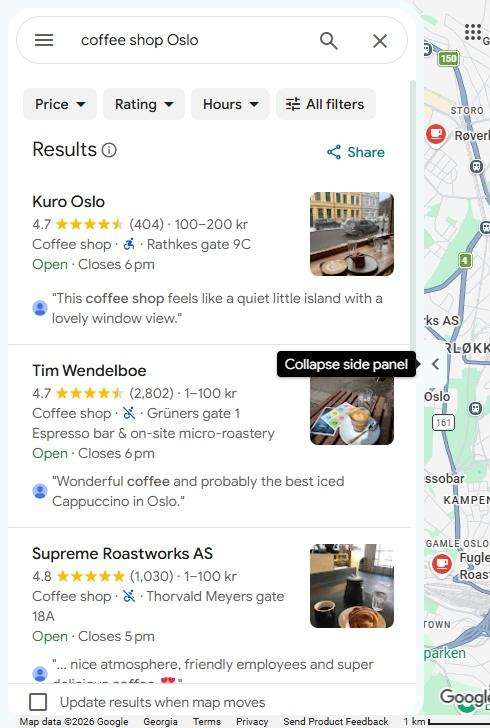
Why it comes out this way: customers search near themselves and trust the map and its reviews. Google's help says businesses with complete and accurate information are more likely to show up in local results (how local ranking works). Step 3 shows what to do with this answer.
Step 2. Ask what the internet knows about you and your competitors (3 minutes)
Do this on someone else's phone or computer, not your own: AI assistants and search adapt to you, and you will not see what a stranger sees. Use a friend's phone or a private window, start a new chat without history and, if you can, turn web search on. Ask three questions of different types:
- Direct: "What do you know about [business name] in [Oslo]? What are its reviews, pros and cons?"
- By category: "Recommend the five best [dental clinics, coffee shops, hotels, hair salons] in [Oslo or a district such as Grünerløkka, Majorstuen, Frogner, Tøyen]."
- By the customer's situation: "Where in [Oslo] can I find [service] [with a condition: open from 8 a.m., parking, kids welcome, English spoken]?"
If you are a specialist, not a company (a tradesperson, doctor, lawyer, coach), put your name and city instead of the business name in the first question, and your profession in the other two.
Here is a dated example of what an assistant relies on. We asked "How do I find a good coffee shop in Oslo?" in Perplexity (not signed in, clean browser, 23 November 2026, 13:12). It named one coffee shop and cited 10 sources, all of them travel guides and lists of cafés; Google Maps was not among them. ChatGPT (not signed in, 13:15 the same day) named five coffee shops and wrote under the list that its selection was informed by current Oslo coffee guides and local business listings. Gemini (signed in, temporary chat, about 13:32) put this among its tips: "Use specialty coffee directories", and named European Coffee Trip and Filter Notes. Three assistants and one request in one city is an example, not a rule, but it shows why guides and directories matter.
Read the answers to the end, including the reviews the assistant retells. If you do not influence them, someone else does. The sooner you see it, the better.
What counts as a poor result, and what to do next:
| What you see | What it means | What to do |
|---|---|---|
| The assistant says nothing about your business | Few confirmed facts about you online | Check that your map listing exists and is verified: how to add your business to Google and Google Maps; check that you are in our directory: find your city and category, for example Restaurants Oslo, Coffee Shops & Espresso Bars Oslo, Hotels & Resorts Oslo, Dental Clinics Oslo, Hair Salons & Haircare Oslo |
| Wrong address, phone or hours | Your details differ from place to place | Name, address and phone must match everywhere, how to check, where wrong information in ChatGPT comes from |
| It recommends your competitors | They have more confirmations: reviews, directories, mentions | Open their public listings and compare: primary category, number and freshness of reviews, photos, description, owner replies |
| Reviews are old or poor | People and AI both see rating and freshness | How to ask for reviews within the rules, how to reply to reviews |
When you compare with competitors, look at their public listings: what is filled in there that is missing from yours. You do not need to copy them, you need to close your own gaps.
Step 3. Put in order everything where you are written about
Look at your maps, your profiles, local directories, articles, mentions on forums and blogs, and make sure the picture of you there is complete and truthful. In this order:
- Your map listing. Fill it in completely. Google's help says customers are 2.7 times more likely to consider a business reputable, 70% more likely to visit and 50% more likely to consider buying when its profile is complete (Complete your Business Profile on Google; no date on the page, read on 23.11.2026; these are Google's own figures). Start with the primary category: a wrong category brings the wrong customers.
- Name, address, phone identical on maps, on your website and in directories: what NAP is.
- Directories. In my checks the assistant names them in second or third place, and they are among the places it takes information from: in Yext's study of 6.8 million source citations in answers from ChatGPT, Gemini and Perplexity (collected 1 July to 31 August 2025), 42% of citations pointed to directories and listings and 44% to the businesses' own websites. This is my experience, not a rule of any assistant; the data we can show is Yext's. Start with the directory you are reading now: find your business in the city category and check the details and photos. If there is no listing or it is out of date, the page Marketing for local businesses explains how to add a business and what the paid plan gives. Other directories: how to build citations yourself, step by step. Visitors and iPhone users use other maps and navigators, so after the main ones check Bing and Apple Maps.
- Photos. Show real pictures of the place, the work and the team: which photos to add. A Google guide for small businesses says businesses that add photos get 42% more requests for directions (source: Google internal data, no date in the document).
- Reviews. Ask happy customers for a review after the visit: send a link in a message, and the person leaves the review from their own phone and their own mobile data, not from your device or your Wi-Fi (the last part is our experience, not a Google rule). We make the link and QR code step by step: how to create a link and QR code, asking by SMS and WhatsApp.
- Articles, forums, blogs. Find what is written about you and answer to the point. Publish your own material on your website and in the blogs your customers read. How other businesses do it: our section Local marketing and the cases.
What not to do. Do not pressure a customer for a review on the spot and do not offer a discount for one: Google's content policy does not allow requiring or pressuring customers to leave ratings, offering incentives for reviews, or selectively asking only happy customers (Prohibited and restricted content, no date on the page, read on 23.11.2026). Google treats bought reviews as fake engagement and removes them. Google's help also names soliciting reviews through incentives or "review stations" as a violation (Complete your Business Profile on Google). The same Google guides for small businesses suggest a QR code on a receipt, a menu or a shop window: the person scans it themselves and leaves a review. Standing over a guest and pressing them is not allowed.
Run a business in Norway?
If you have no time to deal with maps, directories and AI answers, the Madloba Consult team does it for businesses. What is included and what it costs is on the advertising page: Marketing for local businesses. You can also request 3 tips for your Google Maps listing there. We do not guarantee any place in AI answers.
Questions and answers
AI assistants and search adapt to you. In our experience, if you often opened your own bakery's page, the system does not know it is yours and takes it for a place you like, so it shows it to you higher than to a stranger. You see not what your customer sees. Google's help describes the general mechanism for its search: results can differ between people because of location, language and device, and, when personalization is on, because of your search history and activity (Why your Google Search results differ from others, Personalization and Google Search results). How exactly each AI assistant does this is not published, so the bakery example is our experience, not a rule. A friend's phone, a private window and a new chat remove most of it. Location and language still apply, so use a phone in your city, as a customer would.
Any of the main ones: ChatGPT, Gemini, Claude, Perplexity or Google's AI Mode. Customers use different ones and the answers differ, so ask two or three. If you have time for one only, take the one your customers most likely use. We have no data on which that is in Norway.
None of them on its own. Ask the same question in two or three assistants on different days and see what repeats. If you are never named, that is a signal.
This is common for new and small businesses and it is the easiest result to fix: the assistant has nothing to retell. Start with a verified map listing and a few directories (the table in step 2 has the links), then ask again in a few weeks. We do not promise a date when it will appear.
Find where it comes from: often an old directory entry, a listing nobody maintains or an old review. Fix it at the source (the listing, the directory, your website) and ask again. If the assistant offers a way to flag a wrong answer, use it, but in our experience a fix at the source works more reliably. More: ChatGPT shows wrong information about my business.
In our practice, once a month and after any change of name, address, phone or hours. This is our routine, not a rule of any platform.
A website helps: in Yext's study 44% of citations in AI answers pointed to company websites. But without a map listing and directories, a website alone is usually not enough.
A Google listing, basic entries in most directories and asking for reviews are free. You only pay someone who does it for you, and an honest contractor's promises are limited: what an AI visibility agency can honestly promise.
Yes. Steps 1 and 2 need nothing but a phone. Most of step 3 (listing, directories, photos, asking for reviews) an owner can do over a few weeks using our guides. A specialist is worth hiring when you have no time, several locations or a listing that is blocked or not verified.
The same three steps. In step 2 use your name and city instead of a company name, and ask by profession too ("Recommend five [profession] in [city]"). In step 3 put in order the places where you are named: a map profile if you can have one, professional directories, your website or page, reviews. Google's guidelines let public-facing professionals with their own customer base have a profile of their own (they name doctors, dentists, lawyers, financial planners, and insurance and real estate agents) if customers can meet them at the address during posted hours; support staff should not create their own profiles. Check the conditions on the page: Guidelines for representing your business on Google.
Yes, that is step 2: how to check AI recommendations.
What next
The full version of this check, with a checklist and links to Google's help pages, is on the Madloba Consult site: 5 minutes, 3 steps: check yourself in AI answers. Free guides and checklists: madlobaconsult.com/guides. Tell us in the comments who the assistant named in your field in Oslo and what you found. We update this article when new research comes out or Google's rules change.
Read also:
What is a rule and what is our experience
- Platform rules and data: Google's content policy on reviews (pressure on the spot, incentives, selective asking, fake engagement); Google's own words on the value of a complete profile (the 2.7 times, 70% and 50% figures); the effect of complete data on local results (help 7091); that results differ between people by location, language, device and, with personalization on, search history (Google Search Help, pages 12412910 and 12410098); who may have a profile of their own (3038177).
- Research (not Google's data, these are surveys and company studies): BrightLocal 2026 (45% and 6%, 40%, 31% and 17%, 74%), Yext 2025 (44%, 42%, 8%).
- Our experience, not rules: that in the owner's checks (two or three times, different browsers) the assistant almost always puts Google Maps and reviews first and names local directories in second or third place (one dated example, ChatGPT, 23.11.2026, had no directories; the supporting data is Yext's); checking from someone else's device and in a new chat, and the bakery example of why (the system does not know the place is yours and shows it higher to you; how each AI assistant does this is not published); asking for a review by link after the visit, from the customer's own phone and mobile data; the order of steps 1 and 3; how often to check.
- Where we write "in our experience", it is what we have seen on our clients' listings, not a platform rule. Platforms do not disclose their algorithms so that nobody games them, and we may be wrong.
Sources
- BrightLocal, Local Consumer Review Survey 2026, published 11 February 2026, 1,002 US adults: https://www.brightlocal.com/research/local-consumer-review-survey/ (read 23.11.2026)
- Yext, study of AI answer sources, press release of 9 October 2025: https://www.yext.com/about/news-media/ai-citations-release
- Google, Complete your Business Profile on Google: https://support.google.com/business/answer/10515606 (read 23.11.2026)
- Google, Improve your local ranking on Google: https://support.google.com/business/answer/7091
- Google, Prohibited and restricted content: https://support.google.com/contributionpolicy/answer/7400114 (read 23.11.2026)
- Google Search Help, Why your Google Search results differ from others: https://support.google.com/websearch/answer/12412910 (read as a search fragment 23.11.2026)
- Google Search Help, Personalization & Google Search results: https://support.google.com/websearch/answer/12410098 (read as a search fragment 23.11.2026)
- Google, Guidelines for representing your business on Google (individual practitioners): https://support.google.com/business/answer/3038177 (read 23.11.2026)
- Google, GBP best practices playbook 2026 for service businesses: https://services.google.com/fh/files/helpcenter/services_gbp_best_practices_playbook_2026.pdf (read 23.11.2026)
Share
Save

Read also
Geomarketing, GEO and local SEO: what's the difference and why local businesses need all three (2027 guide)
Geomarketing, local SEO and GEO are three different things. A plain guide to why each works poorly alone, plus a 15-minute self-check.
Your competitor isn't across the street: who is really taking your customers (2027 guide)
Your competitor is whoever your customer paid instead of you. Three circles of competition, honest cases from practice, a before-and-after table by niche and a…
Local marketing and GEO for business services in Norway
How a solo lawyer, accountant or consultant in Norway can get enquiries online: short videos, a clear address, evening contact and a lawyer case.
GEO: how a company gets recommended by ChatGPT and other assistants
What GEO means for a local business in Norway, what we saw in three real cases, what we cannot promise and five checks you can do this week.

Local visibility in Norway: how to make your business easier to find on Google nearby
How Google's local results work in Norway: relevance, distance and prominence, and what to do with categories, services, hours, photos and reviews.

What does a Google Business Profile cost in Norway, and when is paid help worth it?
A Google Business Profile in Norway is free. What businesses pay for, when agency help is worth it, and how to vet a provider before you sign.
0 comments
Log in to leave a comment