


Norwegian for travellers: 100 useful words and phrases (phrasebook)
Share
Save
Almost all Norwegians speak good English, so you will manage fine without Norwegian. Still, a "hei" and a "takk" open many doors, and signs, menus and train announcements are often only in Norwegian. Here are the words and phrases travellers actually use, sorted by situation, with rough pronunciation. For more about the language, see What language is spoken in Norway? and Do Norwegians speak English?
A little about Norwegian before you start
Norwegian and Sámi are official languages in Norway. Norwegian has two equal written standards, Bokmål and Nynorsk, and a great many dialects, so the same word can sound different in Bergen and in Tromsø. Signs and menus are usually in Bokmål, and that is what we use here. Norwegians often understand Swedish and Danish, and many Norwegian words look like English and German. See What is the difference between Bokmål and Nynorsk? and How many dialects does Norwegian have?
How to pronounce Norwegian letters
| Letter | Sounds roughly like | Example |
|---|---|---|
| æ | like "a" in "cat" | bær (berry), være (to be) |
| ø | like "u" in "burn" or German "ö" | brød (bread), øl (beer) |
| å | like "o" in "more" | på (on), Ålesund |
| kj | a soft "h" sound, like German "ich" | kjøtt (meat), kjøre (drive) |
| sj, skj | like "sh" in "shop" | sjokolade (chocolate), skjorte (shirt) |
| g before i and y | like "y" in "yes" | gi (give), gyllen (golden) |
| hv | the "h" is silent | hva (what), hvor (where) |
| rd, rt, rn | the r blends into the next letter | bord (table), kort (card) |
Pronunciation varies by dialect. Checked against the Language Council and the official dictionaries, 27 November 2026.
Greetings and politeness
"Hei" works in almost every situation, from the shop to a meeting with the boss. Norwegians say "du" (you) to everyone, including strangers and older people, and the formal "De" is almost never used. There is no everyday word for "please": instead you say "kan jeg få …" (can I have …) and end with "takk". See How do you say hello in Norwegian? and How do you say please in Norwegian?
Greetings and politeness
| Norwegian | English | Pronunciation (roughly) |
|---|---|---|
| Hei | Hi / hello | hai |
| God morgen | Good morning | go MÅRR-en |
| God kveld | Good evening | go kvell |
| Ha det (bra)! | Goodbye (take care) | HA-de bra |
| Takk / tusen takk | Thanks / thanks a lot | takk / TU-sen takk |
| Vær så god | Here you are / you are welcome | vær-so-GO |
| Unnskyld | Excuse me / sorry | UN-shyll |
| Ja / nei | Yes / no | ja / nai |
| Snakker du engelsk? | Do you speak English? | SNAK-ker du ENG-elsk |
| Jeg forstår ikke | I don’t understand | jai for-STÅR IK-ke |
| Jeg heter … | My name is … | jai HE-ter |
| Hyggelig å treffe deg | Nice to meet you | HYG-ge-li o TREF-fe dai |
Pronunciation is simplified; stressed syllables are in capitals.
At the café and restaurant
You often order at the counter, even in many restaurants, and pay by card; cash is rare. Tipping is not expected, but many people round up. "Takk for maten" (thanks for the meal) is said to whoever cooked or paid, and it is much appreciated. See How do you say cheers in Norwegian?, How do you say thank you? and restaurants in Oslo.
At the café and restaurant
| Norwegian | English | Pronunciation (roughly) |
|---|---|---|
| Kan jeg få en kaffe? | Can I have a coffee? | kan jai fo en KAF-fe |
| Et glass vann, takk | A glass of water, please | et glass vann, takk |
| Har dere et bord til to? | Do you have a table for two? | har DE-re et bor til to |
| Hva anbefaler du? | What do you recommend? | va AN-be-fa-ler du |
| Jeg er vegetarianer | I am vegetarian | jai ær ve-ge-ta-ri-A-ner |
| Regningen, takk | The bill, please | RAI-ning-en, takk |
| Kan jeg betale med kort? | Can I pay by card? | kan jai be-TA-le me kort |
| Skål! | Cheers! | skål |
| Takk for maten | Thanks for the meal | takk for MA-ten |
"Kan jeg få …" is the politest and most common way to order.
In the shop and on the move
At stations and on buses, the key words are "avgang" (departure), "spor" (platform) and "forsinket" (delayed). Watch out with clock times: "halv tre" means 14:30, not 15:30. See What does halv tre mean?, Question words in Norwegian and, for the trip from the airport, From Oslo Airport to the city.
In the shop and on the move
| Norwegian | English | Pronunciation (roughly) |
|---|---|---|
| Hvor mye koster det? | How much is it? | vor MY-e KOS-ter de |
| Trenger du pose? | Do you need a bag? | TREN-ger du PO-se |
| Kvittering | Receipt | kvit-TE-ring |
| Åpent / stengt | Open / closed | O-pent / stengt |
| Tilbud / salg | Offer / sale | TIL-bud / salg |
| Billett | Ticket | bil-LETT |
| Tog / buss / trikk / ferje | Train / bus / tram / ferry | tog / buss / trikk / FER-je |
| Hvor er …? | Where is …? | vor ær |
| Holdeplass / stasjon | Stop / station | HOL-le-plass / sta-SHON |
| Til venstre / til høyre / rett fram | Left / right / straight on | til VEN-stre / til HØY-re / rett fram |
| Avgang / ankomst / forsinket | Departure / arrival / delayed | AV-gang / AN-kåmst / for-SHIN-ket |
| Inngang / utgang | Entrance / exit | INN-gang / UT-gang |
Words you will see on signs in shops, stations and at the quay.
When something goes wrong
In an emergency you can always speak English on 113, 112 and 110. The words below help you understand signs and explain yourself at the pharmacy. How to get medical help is covered in Fastlege and legevakt.
When something goes wrong
| Norwegian | English | Pronunciation (roughly) |
|---|---|---|
| Hjelp! | Help! | jelp |
| Ring 113! | Call 113! | ring en-en-tre |
| Jeg trenger en lege | I need a doctor | jai TREN-ger en LE-ge |
| Legevakt | Out-of-hours clinic | LE-ge-vakt |
| Apotek | Pharmacy | a-po-TEK |
| Politi | Police | po-li-TI |
| Jeg har mistet … | I have lost … | jai har MIS-tet |
| Det gjør vondt her | It hurts here | de jør vånt hær |
113 is ambulance, 112 police and 110 fire.
Numbers and days
| Norwegian | Means |
|---|---|
| en, to, tre | 1, 2, 3 |
| fire, fem, seks | 4, 5, 6 |
| sju, åtte, ni, ti | 7, 8, 9, 10 |
| tjue, femti, hundre | 20, 50, 100 |
| mandag, tirsdag, onsdag | Monday, Tuesday, Wednesday |
| torsdag, fredag | Thursday, Friday |
| lørdag, søndag | Saturday, Sunday |
| i dag, i morgen, i går | today, tomorrow, yesterday |
"Sju" and "syv" both mean 7.
False friends and Norwegian habits
False friends: words that trick visitors
"Gift" means both married and poison. "Rar" means strange, not rare. "Frisk" means healthy, not chilly. "Bra" means good, not underwear. "Kjør!" means "let’s go". "Fart" on road signs means speed.
Norwegians say thank you a lot: for the meal, for last time and for today. "Takk for sist" (thanks for last time) is what you say the first time you see someone again after a visit. "Kos" and "koselig" mean cosiness and are used for everything from a café to an evening with friends. If you learn only three words, make them "hei", "takk" and "unnskyld".
Want to learn more?
There are good free resources. If you are moving to Norway, you will find language courses in our directory, and many municipalities offer Norwegian tuition.
More about learning the language: What is the best way to learn Norwegian?, Is Norwegian hard to learn? and Norwegian courses in Oslo. If you need help with documents, see translation services in Oslo.
Frequently asked questions about Norwegian for travellers
No. Almost everyone speaks good English, but a few words help you read signs, menus and train announcements.
Hei and takk. "Tusen takk" means thanks a lot, and "ha det" means goodbye.
It is not common in everyday speech. Say "kan jeg få …" (can I have …) and end with "takk".
Æ like a in "cat", ø like u in "burn", and å like o in "more".
They are two equal written standards of Norwegian. Most people write Bokmål, while Nynorsk is used most in western Norway.
Halv tre means 14:30 or 2:30, half an hour before three.
Yes. NTNU offers the free beginners’ course Norwegian on the Web, and the dictionaries at ordbøkene.org are free.
Sources
The sources we checked the language facts against (last checked 27 November 2026).
Share
Save

Read also

Norwegian for newcomers: tuition, rights and documentation
Find the right contact for Norwegian tuition. Understand rights, obligations, approved providers and course versus test documentation.

Practical Norwegian grammar: word order and short messages
Place verbs and ikke, form questions and check common word forms. Original Bokmål examples, two tables and dictionary guidance.
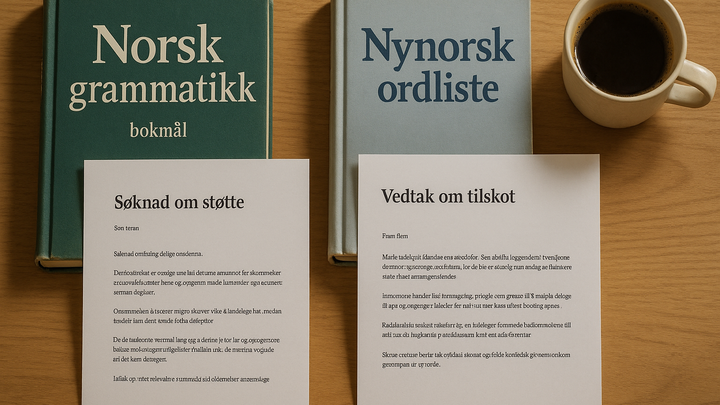
Norwegian language: Bokmål, Nynorsk and everyday dialects
Understand written Norwegian and dialects, read official letters, check word forms and clarify school language choices.
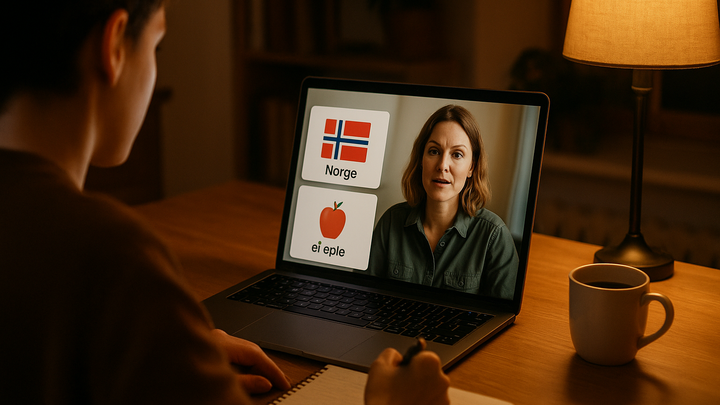
Norwegian classes alongside work: choose a format and goal
Compare online groups, self-study and teacher sessions. Check work needs, provider approval and the meaning of course certificates.
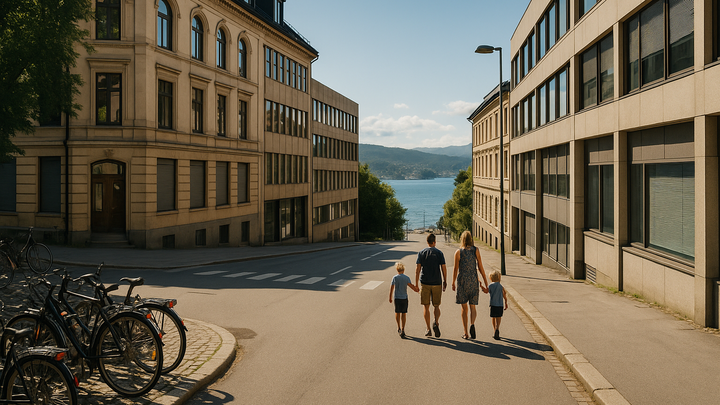
What is fellesferie, and how does it affect work and travel in Norway?
🗓️ What is fellesferie, how does the rhythm of cities change in July, when to book accommodation, where to find peace and quiet, and what to look out for in th…

How can you keep a daily rhythm through Norway’s polar night?
Build a daily routine for Norway’s polar night: regular wake-up times, outdoor breaks, social plans, visibility after dark and a calm evening.
0 comments
Log in to leave a comment