



Northern lights in Lofoten: seasons, locations and a practical evening plan
You can look for the northern lights in Lofoten from late summer to early spring, once nights are dark enough. Choose accommodation that works in poor weather, follow cloud conditions and use a safe, permitted place with an open view of the sky. More nights give you more opportunities, but no beach, high Kp reading or booked excursion guarantees a sighting.
When should you travel?
Visit Lofoten places the viewing season approximately between late August and early April. Treat that as a planning window, not a timetable. The sky needs to be sufficiently dark, and clouds need to leave a view through. An evening at either end of the season offers a different experience from a long midwinter night.
Choose dates for the whole holiday. Early autumn can combine evening viewing with more daytime activities. Midwinter suits a slower itinerary built around limited daylight. Later in winter, longer days give landscape exploration and aurora viewing separate parts of the day. Snow and road conditions vary; a photograph of a snowy beach is not a forecast for your visit.
Avoid making your arrival evening the only opportunity. Delayed transport, cloud or simple tiredness might make staying indoors sensible. Several evenings let you wait for better conditions without squeezing a long drive between landing and an early departure.
Choose your base before your photography location
Start with accommodation, food and transport. Svolvær may suit travellers who want nearby services and wish to investigate organised excursions. A smaller settlement may put darker surroundings closer to your door, but you need to establish where you will eat, how you will arrive and what happens when the weather changes.
Look at actual access outside the property. A waterfront address might mean a terrace over the sea, a small courtyard between buildings or a road without a pavement. Ask the host where guests can stand after dark without entering private land. A safe viewing area a few minutes from bed can be more useful than a famous beach a long drive away.
Self-catering supports flexible evenings if you have bought supplies first. A hotel restaurant can simplify the day, but confirm its service hours. Neither accommodation type increases solar activity. The choice is about comfort and workable arrangements during a cloudy evening.
Use the Svolvær directory to locate local places and services. The Nordland overview provides regional context, while NorgeGuide rankings can suggest other stops. Check opening hours and current services with each business before relying on it during a winter stay.
Locations to consider
Beaches often appear in aurora recommendations because they offer broad skies and a recognisable foreground. This does not make the waterline safe in every condition. Wind, waves, ice, parking and local restrictions all need attention. No composition justifies standing beside breaking waves or climbing onto slippery rocks.
| Area | Why consider it | What to establish |
|---|---|---|
| Uttakleiv, Vestvågøy | Open beach and recognisable photographic foreground | Parking, local charges, wind and distance from waves |
| Haukland, Vestvågøy | Beach scenery near the Leknes area | Safe access after dark; a summer route is not a winter plan |
| Hov, Gimsøy | Open coastal surroundings | Access, parking and consideration for local businesses |
| Ramberg, Flakstadøy | A beach to consider from a western base | Suitable stopping places and conditions along the drive |
| Near your accommodation | Short return and easy access to warmth | Private land, lighting, surface conditions and the actual view |
Treat these locations as a shortlist to investigate in daylight. If possible, inspect the parking area and the route to your viewing position before dark. A summer walking description should not become a winter night itinerary without further assessment. Places such as Kvalvika and Bunes are not straightforward substitutes for a roadside stop when you spontaneously decide to look for aurora.
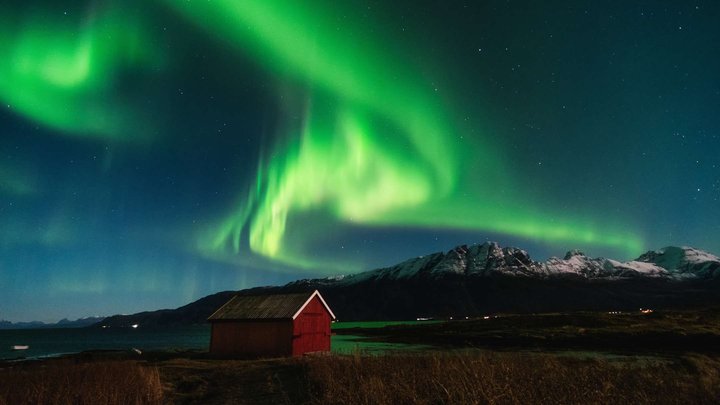
A photograph facing one direction also does not tell you where you must look all evening. The display can move and change shape. Select a place where you can look around comfortably, and give safe access more weight than the desire to frame a particular mountain.
How to use the forecasts
Consider three separate questions: will it be dark, where are the clouds, and is there geomagnetic activity? An aurora forecast cannot answer all three on its own. A high index does little for an observer beneath unbroken cloud, while lower activity may still be interesting at this latitude.
Kp is a global measure of geomagnetic activity rather than a local score for tonight's photographs. Lofoten's northern position means you do not need to wait for the highest readings before checking the sky. Yr provides both a longer forecast and a shorter nowcast. Use these alongside cloud information and your own observations, rather than treating them as a commitment from the sky.
Also check wind and the weather along the journey. A small forecast gap in cloud may be too temporary to justify a long drive. Make a local plan A and a realistic plan B. If both require difficult driving, staying near your accommodation can be the evening's sensible plan.
Refresh the information close to departure. A screenshot from breakfast cannot show a later change. Download useful maps and save the accommodation address, but remember that saved information will not show a newly closed road or a fresh weather warning.
Hire car, guided tour or public transport?
A hire car provides flexibility and responsibility for winter driving and parking after dark. Decide where you can stop before setting off. Do not brake suddenly when a green band appears, and do not turn a narrow verge into a viewing area. The driver needs to concentrate without passengers expecting an immediate stop for every glimpse.
A guided excursion can suit travellers who do not want to drive. Ask about meeting arrangements, possible duration and the operator's response to poor weather. Establish whether warm clothing, photography assistance or a return transfer to your accommodation is included. The words “northern lights tour” describe a theme, not a standardised package.
Public transport can help you move between bases and reach daytime activities. A useful afternoon bus does not mean there is a return service after a late observation session. Reis Nordland provides journey planning and service notices. Search both directions for your actual date and establish a fallback before leaving the vehicle at a small stop.
Without a car, accommodation with a safe nearby viewing position becomes especially useful. A taxi may be an option, but booking arrangements, availability and fare need checking beforehand. Do not assume an available car will happen to be waiting beside a beach late at night.
Build an evening that can change
Eat before leaving and prepare clothes, camera and transport without rushing. Aurora viewing often involves standing still. Clothes that felt warm on an active daytime walk may be insufficient while waiting. Keep an extra warm layer accessible without unpacking the entire bag.
Agree on a stopping point with your companions in advance. It might be someone getting cold, deteriorating weather or the need to return for sleep. A shared decision before departure makes it easier to finish without anyone feeling responsible for spoiling the trip.
| Conditions | Possible decision | Avoid |
|---|---|---|
| Clear sky near the base | Start with a short local outing | Driving far simply because another location is famous |
| Local cloud with better conditions nearby | Consider a previously checked alternative | Chasing every new point shown in an app |
| Strong wind or difficult roads | Stay beside safe access or indoors | Pushing ahead with a drive because it was planned |
| Faint visible light | Give your eyes time and try a steady photograph | Declaring the evening over after one quick glance |
| Someone becomes cold or tired | Finish or take a warm break | Letting photography dictate everyone's limits |
For three evenings, a workable structure might be a short observation close to the base on arrival, a more flexible outing when conditions look most promising, and a final evening without a long transfer before departure. This is an example of arranging effort, not a claim that three nights will deliver a sighting.
The following day matters too. Avoid pairing a very late excursion with an early, demanding drive. Leave room for meals, rest and something enjoyable if the night stays cloudy. That creates a holiday with value beyond the photograph you hoped to take.
You can also divide responsibilities. One person checks transport, another keeps an eye on the local sky, and everyone knows the return arrangement. This reduces repeated phone checking and confusion. If travelling alone, tell your host or another contact where you intend to go and when you expect to return, particularly when leaving a busy area.
Clothing and care beside the sea
Dress in layers and choose outer clothing for wind and precipitation. Keep your hands warm while using a phone or camera; thin liner gloves under warmer mittens can make small adjustments easier. A dry spare item helps if your hands or feet become wet.
Carry a light for access and wear reflective items where vehicles may pass. Point the beam down when walking beside people taking photographs, but use enough light to see the ground. A photograph is less important than getting safely to and from your position.
Stay back from the water even if the beach looks calm. Darkness makes waves and slippery patches harder to judge. Do not climb onto rocks to reproduce a picture. Respect fences, notices, payment areas and land used by residents or farming operations. Take all rubbish away.
Varsom is useful when assessing natural hazards and terrain. A low warning level, or the absence of a warning relevant to a particular point, does not replace assessment of the place where you are standing. For a simple aurora evening, an established stop with straightforward access is often a better choice than steep terrain.
Take photographs without losing the evening
Practise indoors first. Find your phone's night mode, or learn how to change shutter speed and focus on your camera. Outside, a stable tripod and a delayed release can reduce movement. Take a test shot, inspect the stars for sharpness and adjust according to the result.
A longer exposure may reveal faint light more clearly but can blur the shape of a fast-moving display. A camera may also record stronger colour than your eyes perceive. The evening has not failed because the sky looks faint or grey-green to you rather than matching a saturated image.
Put the phone down occasionally. Watch the movement, turn around and allow time away from a bright screen. One simple photograph and an attentive experience may be more rewarding than spending the entire evening fighting unfamiliar settings.
For groups, agree where tripods will stand so that nobody trips over a leg while looking upward. Keep paths clear and avoid spreading equipment across a parking area. A compact setup is easier to move when conditions change and less likely to interfere with other visitors.
Frequently asked questions
It can be possible with clear skies and visible activity, although buildings and artificial lighting affect the view. Find a safe position with an open sky and check local access. Leaving town is not automatically necessary every evening.
It is a well-known photography location, but the best choice depends on cloud, wind and ground conditions. A short, safe outing to a less famous spot may work better on a particular evening.
No. Viewing is possible during the darker part of the year outside midwinter. Choose a month for daylight, other activities and manageable transport, rather than simply maximising dark hours.
No. Moonlight affects the appearance of the sky and landscape, but it is not a reason to cancel by itself. Consider cloud, activity and the actual conditions when you are outside.
An app is a planning aid. It cannot determine whether your road is open, your parking space is permitted or a local cloud covers the sky. Combine forecasts with current transport information and observation.
Not necessarily. A suitable base and an organised excursion can work. Without a car, investigate the return journey carefully because ordinary public transport is not designed around late photography stops.
No. Views, lighting and safe outdoor space vary between properties. Ask about the specific accommodation. The description rorbu does not tell you how much sky you can see from outside.
Adapt duration, clothing and distance to their needs. A short wait near a warm room may work better than many hours in a vehicle. Check the operator's own age limits when booking an organised activity.
Enjoy the places, food and activities you wanted to experience anyway. Do not try to rescue the holiday with risky driving. Aurora is a possible highlight; the rest of the trip should remain worthwhile without a guarantee.
It may work, but leaves little margin for delays or tiredness. Read cancellation terms and check the meeting time. A flexible arrival evening is often easier than a tightly connected programme.
Read also
Northern lights in Tromsø: season, forecasts, tours and viewing places
Northern lights may be visible in Tromsø from late August to early April when the sky is dark and sufficiently clear.
Northern lights in Norway: when and where can you see them?
When and where to see the northern lights in Norway: season, best month and time, Kp index, Yr aurora forecast, tour prices and photo tips.
0 comments
Log in to leave a comment