



Northern lights in Norway: when and where can you see them?
Short answer: The northern lights are best seen in Northern Norway – Tromsø, Alta, Senja, Lyngen, Lofoten, Vesterålen, Narvik and Bodø – from late August to late March, when the sky is dark and clear. Peak time is often 11 pm to 2 am. Clouds matter more than the Kp number: check the aurora and cloud forecast on Yr that evening and drive to clear skies.
Updated 26.09.2026 · Facts checked 26.09.2026 by the NorgeGuide editorial team
Northern lights in Norway – key facts
- Season: late August to late March. Source: Visit Norway, checked 26.09.2026.
- Most activity: statistically autumn (September–October) and spring (March–April). Source: Visit Norway, checked 26.09.2026.
- Best time of night: often 11 pm to 2 am. Source: Visit Norway, checked 26.09.2026.
- How often in the north: in the auroral zone the lights are clearly visible on more than half of all nights (when dark and clear). Source: Store norske leksikon, checked 26.09.2026.
- Altitude: usually 100–120 km above ground, from 80 km and rarely above 500 km. Clouds are far lower, which is why they block the view. Source: Store norske leksikon, checked 26.09.2026.
- Kp index: scale 0–9, calculated for every three hours; Kp 5 or more is a geomagnetic storm (G1–G5). Source: NOAA SWPC, checked 26.09.2026.
- Forecast on Yr: aurora forecast up to 3 days ahead and a nowcast 30–90 minutes ahead, 0–100 %. Source: Yr help, checked 26.09.2026.
- Solar activity: on 15.10.2024 NASA and NOAA announced that the Sun had reached its solar maximum period. Source: NASA, checked 26.09.2026.
Can you see the northern lights in Norway?
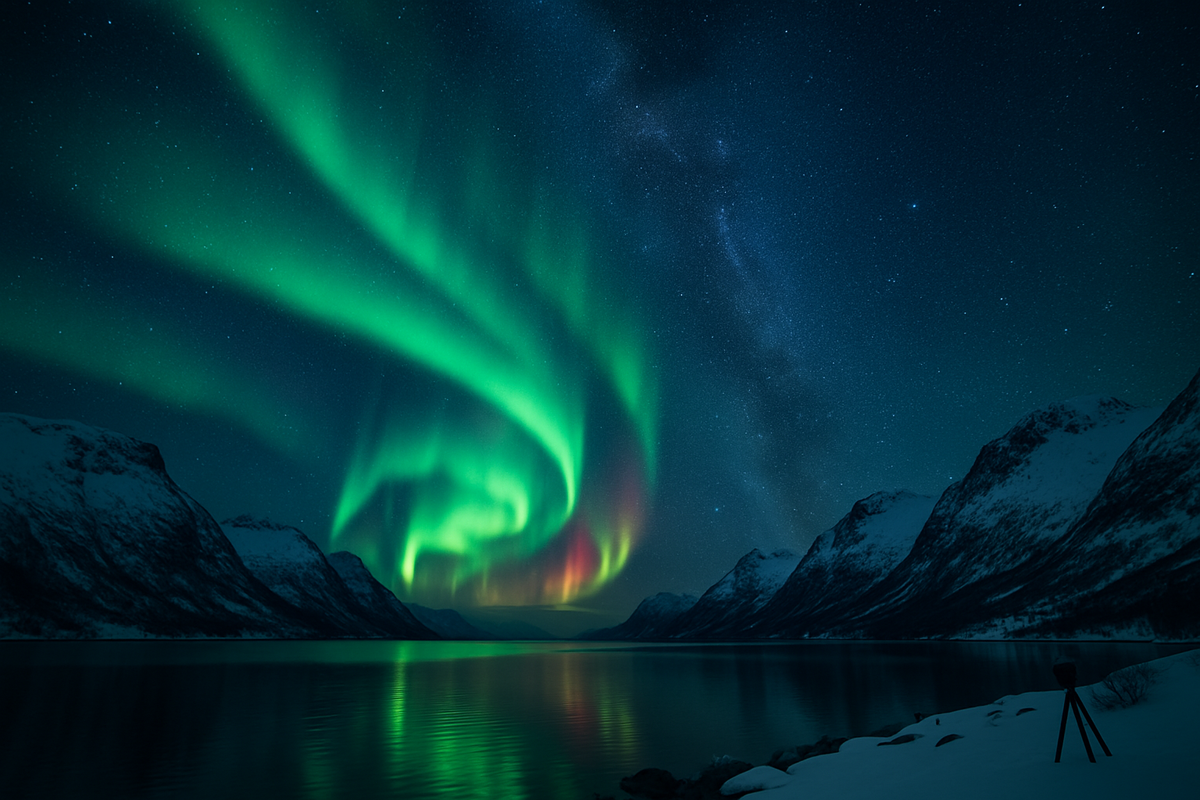
Yes. Norway is one of the best countries in the world for the aurora, because at night the auroral oval lies over the coast of Troms and Finnmark (Store norske leksikon). You need two things: darkness and a clear sky. The lights are there on many evenings – it is clouds and city light that hide them.
Where can you see the northern lights in Norway?
The best area is Northern Norway, north of the Arctic Circle:
- Tromsø – the main hub for aurora trips, with many tour operators and dark skies a short drive from the centre.
- Alta, Lyngen and Senja – good alternatives with fewer tourists (Visit Norway).
- Lofoten and Vesterålen – aurora over mountains and sea, popular with photographers.
- Bodø and Salten, Narvik – easy to reach by plane or train, Narvik also with alpine skiing.
- Svalbard – here the aurora can be seen even in the middle of the day during the polar night, because the daytime auroral oval lies over Svalbard (Store norske leksikon).
Visit Norway notes that the lights are sometimes also seen in Trøndelag and in Western and Southern Norway, especially when solar activity is high.
When is the northern lights season, and which month is best?
The season runs from late August to late March. Autumn (September–October) and spring (March–April) statistically have the most activity, and the weather is often milder than in midwinter (Visit Norway). December and January give the most hours of darkness but often more unsettled weather. From May to July there is midnight sun in the north, and the sky is too bright for the aurora.
What time of night are the northern lights visible?
Most often between 11 pm and 2 am (Visit Norway), but they can appear as soon as it is dark. During the polar night it is dark from afternoon until late morning, so the window lasts many hours. An aurora outburst can last from a few minutes to a couple of hours – go out early and stay out.
How far north do you need to go – and how far south can they be seen?
To see the aurora often, be north of the Arctic Circle (Bodø and further north). In the auroral zone from Lofoten to Finnmark you do not need a high Kp – the lights are right above you. Further south, in Trondheim, Bergen and Oslo, activity must be higher, and the aurora appears low in the northern sky. During strong storms (Kp 5 and above) it can be seen across Southern Norway and further south in Europe. Find a dark spot with a clear view to the north.
What is the Kp index, and what number do I need?
The Kp index measures how disturbed the Earth's magnetic field is, on a scale from 0 to 9. 1 is calm, 5 or more is a geomagnetic storm (NOAA SWPC). It is a global number, calculated for three hours at a time – it does not tell you whether the aurora is above you right now.
- Northern Norway (Tromsø, Alta, Lofoten): the aurora can be seen even at low Kp when it is clear.
- Mid-Norway (Trondheim): a higher Kp gives a better chance.
- Oslo, Bergen and the south: usually a storm is needed, Kp 5 or more.
Use Kp as a guide, not a guarantee. Clouds decide more.
Aurora forecast: how do you know when the lights will appear?
- Yr (Norwegian Meteorological Institute): aurora forecast for your location up to 3 days ahead, plus a nowcast 30–90 minutes ahead. On the same page you see the cloud cover – the most important number.
- NOAA SWPC: the Kp index and the aurora forecast for the next 30–90 minutes.
- Apps: aurora apps show Kp and send alerts at high activity. Always check clouds on Yr as well.
How to do it: check the forecast in the afternoon, look at the cloud map for the evening, and drive to where it is clear. Local guides in Tromsø and Alta often drive far – all the way to the Finnish border – to find clear skies.
Why do clouds matter more than Kp?
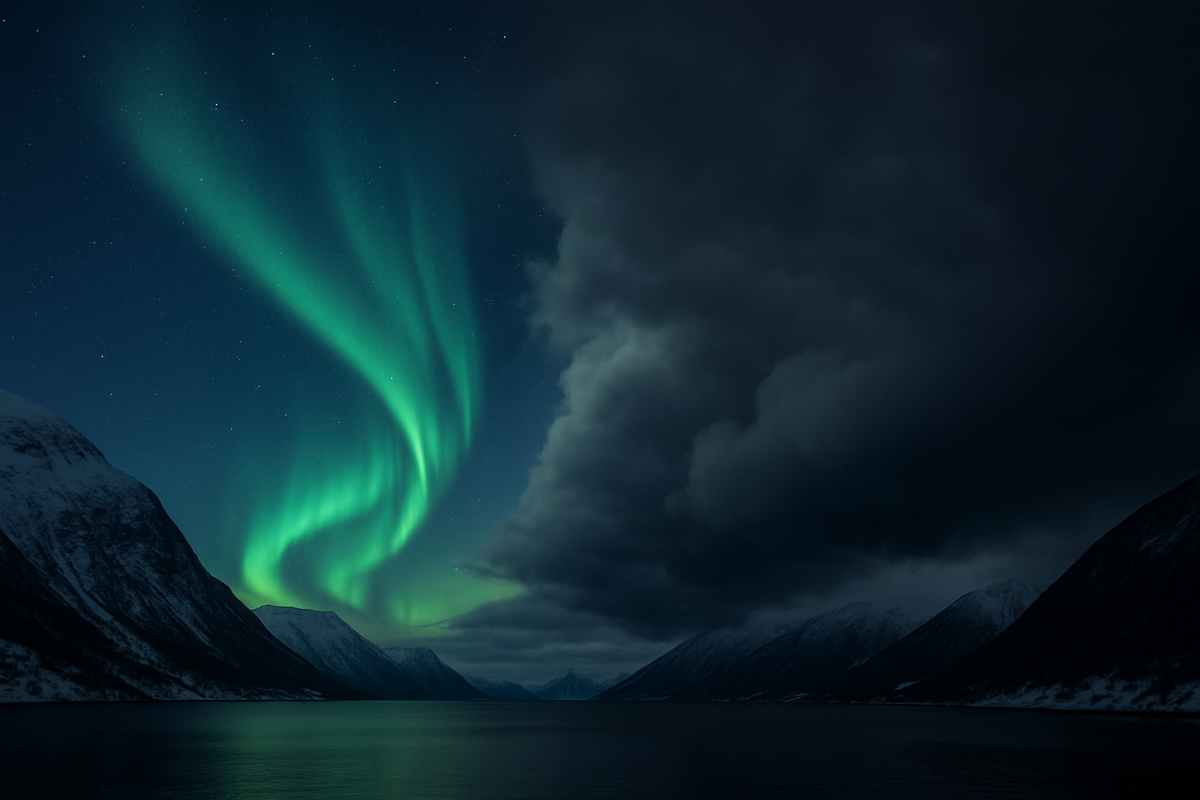
The aurora is 100–120 km above ground, clouds are far lower (Store norske leksikon). Low clouds block everything; thin, high clouds can sometimes be seen through (Yr). When clouds are forecast, look for gaps in neighbouring valleys or inland – it is often clearer than on the coast.
How much does it cost to see the northern lights?
Seeing the aurora itself is free: you only need darkness and a clear sky, and the Norwegian right to roam lets you walk in nature. What costs money is the trip.
- Guided aurora tour by minibus: the price depends on the season, the group size and what is included (thermal suit, hot drinks, hotel pick-up). Check the price with the operator you choose — tour operators in Tromsø, Alta, Bodø and Narvik are in the directory below.
- Rental car: cheapest for a group, but means winter driving on icy roads in the dark.
See tour operators and rentals in the directory below.
How to see the aurora on a tour – and what makes a good guided tour?
A good aurora tour is a "chase": the guide follows the clouds and drives to clear skies rather than staying in one place. Look for small groups, warm clothing included and a guide who helps with photos. If Tromsø is busy, a tour from Alta, Senja or Lyngen may mean fewer people.
How easy is it to see the northern lights – and how often?
In the auroral zone the lights are clearly visible on more than half of all nights (Store norske leksikon). What makes it hard is weather and light. Spend 3–4 nights in Northern Norway during the season and your chances are good. A single evening is a lottery.
How to photograph the northern lights
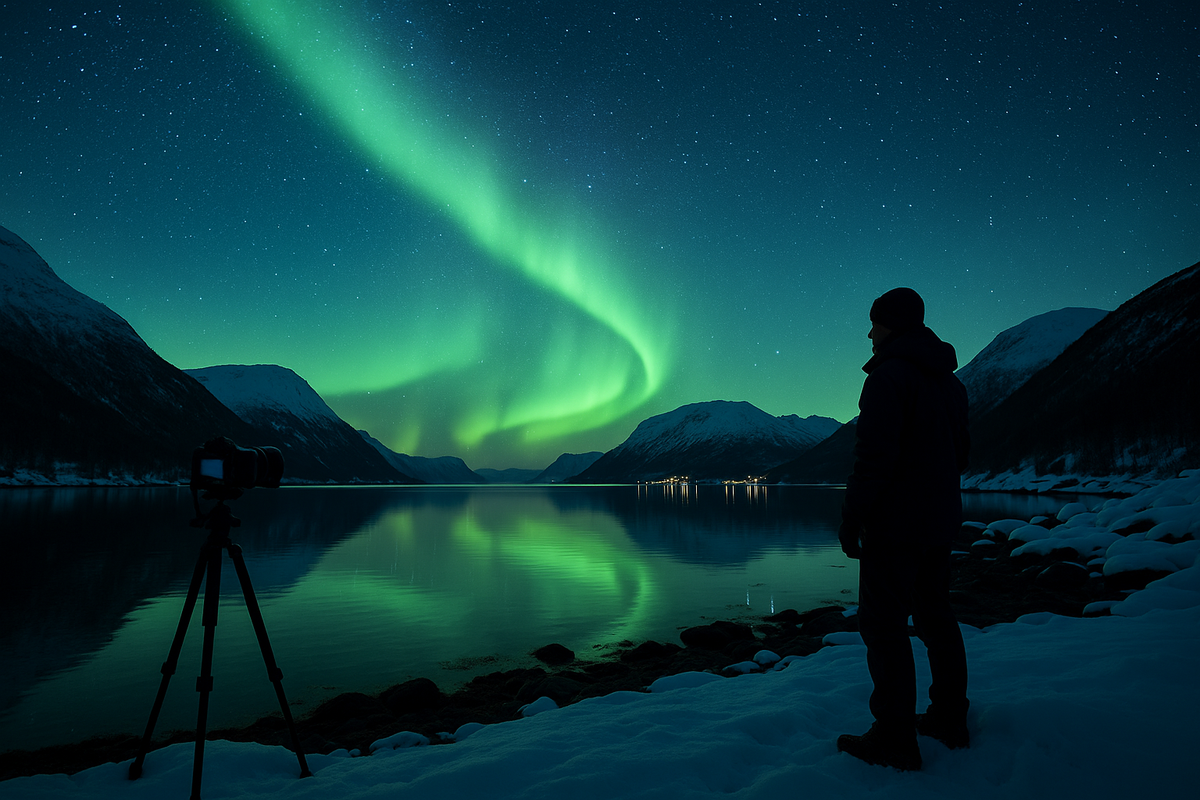
- Use a tripod and manual mode: shutter 5–20 seconds, ISO 800–3200, aperture as wide as possible (f/1.8–f/4).
- Focus manually on infinity, or on a distant light.
- Phone: use night mode and rest the phone on something steady.
- Bring a spare battery – cold drains batteries fast.
Northern lights and the moon
A full moon makes the sky brighter, so faint aurora is harder to see. Strong aurora is still clearly visible, and moonlight can give beautiful landscape photos. At new moon the sky is darkest.
Safety: clothing, cold and driving
- Dress in layers: wool closest to the skin, a warm middle layer, wind- and waterproof outer layer, hat, mittens and warm boots.
- Never stop your car on the road to watch the aurora – pull into a parking area.
- Check weather and road reports before driving. In an emergency call 112 (police), 113 (ambulance), 110 (fire).
- Do not walk alone onto ice, into avalanche terrain or off marked trails in the dark.
Where to stay and book an aurora tour (directory)
- Tromsø: tour operators and travel agencies, hotels and resorts, guesthouses, cabins and campsites, sports and outdoor gear rental, car rental.
- Alta: tour operators, hotels.
- Bodø: tour operators, hotels.
- Narvik: tour operators, hotels.
Read also: hotels in Tromsø and glass igloos in Norway.
Northern lights in myths and folklore
The aurora has many names and stories in Nordic and Sámi tradition, and many of them are about respect for the light in the sky. Today we know what it is: light created when energetic particles from the Sun hit gases in the atmosphere (Store norske leksikon).
Aurora tours for groups and companies
Travelling as a family, a group of friends or a company? Ask the tour operator about a private tour for your group. Ask for a fixed price, warm clothing, transport and a plan B if clouds are forecast, and book early in high season. See tour operators in Tromsø, Alta, Bodø and Narvik in the directory further down.
Sources
- Visit Norway – Northern lights, checked 26.09.2026
- Store norske leksikon – nordlys, checked 26.09.2026
- Yr – aurora forecast, checked 26.09.2026
- NOAA SWPC – Kp index, checked 26.09.2026
- NASA – solar maximum, 15.10.2024, checked 26.09.2026
- Visit Arctic Norway – polar night, checked 26.09.2026
Tour operators for aurora trips in Tromsø


Photos: northern lights in Norway


Northern lights FAQ
From late August to late March, when it is dark and clear.
Occasionally, during strong solar activity (Kp 5 and more) and clear skies, low in the north and away from city lights.
Not in Northern Norway: there is midnight sun and the sky is too bright.
Light created when particles from the Sun hit gases in the atmosphere. Green comes from oxygen; red from oxygen higher up (Store norske leksikon).
From a few minutes to several hours, often in bursts.
Often fainter and more grey-green to the eye; the camera captures more colour.
No, but a guide drives to clear skies and provides warm clothing.
Even low Kp can bring aurora there – clouds matter more.
The Sun entered its solar maximum period in 2024 (NASA/NOAA) and activity remains high – but the weather decides each night.
The period when the Sun does not rise. In Tromsø it lasts about six weeks (Visit Arctic Norway); in Longyearbyen there is no daylight from 11 November to 30 January.


0 comments
Log in to leave a comment