



How do you find winter motorhome stops along Norway's E6?
Share
Save
In brief: Plan winter overnight stops along the E6 around confirmed facilities at the actual site and road conditions, rather than distance to the next town. Statens vegvesen, checked 3 November 2026, warns that some rest areas close in winter and are not intended for prolonged camping. For every night, confirm motorhome admission, access, electricity, water and waste disposal, then choose a backup area.
Where do you start a winter E6 itinerary?
Choose the trip section and actual dates, then find overnight accommodation within a manageable day's drive. There is no universal winter mileage: snow, wind, mountain stretches and fatigue can change the day.
Open Statens vegvesen: traffic information, checked 3 November 2026, and check notices, cameras and the relevant stretch before departure and again before continuing. A road line on a map does not establish current access.
Visit Norway: camping and caravanning, checked 3 November 2026, advises considering winter skills and vehicle equipment. Review vehicle preparation using the winter driving checklist.
The E6 leads to Kirkenes, where Statens vegvesen describes E6 Kirkenes sentrum, checked 3 November 2026. Nordkapp requires a separate branch trip; the E6 does not end at Nordkapp.
Which 15 areas can you search for overnight stops along the E6?
These are search areas from south to north and onwards to the route's eastern endpoint. They are not a list of verified winter campsites. Find a particular site in each selected area and obtain confirmation of services for your date.
Use the map at Statens vegvesen: traffic information, checked 3 November 2026, to verify the actual turn-off and access. Calculate mileage and time from your own starting point, not a generic distance table.
| Order | Search area | What to decide before continuing |
|---|---|---|
| 1 | Svinesund | First night after the border and check-in time |
| 2 | Oslo | Permitted motorhome accommodation and route access |
| 3 | Lillehammer | Overnight stop before continuing up the valley |
| 4 | Ringebu | Site and valley backup |
| 5 | Dombås | Whether to continue across Dovrefjell |
| 6 | Oppdal | Arrival after the mountain stretch |
| 7 | Trondheim | Resupply and vehicle servicing |
| 8 | Steinkjer | Next confirmed overnight stop |
| 9 | Grong | Access, reception arrangements and time buffer |
| 10 | Mosjøen | Winter domestic facilities before the next stage |
| 11 | Mo i Rana | Whether to continue across Saltfjellet |
| 12 | Fauske | Accommodation before or after the mountain stretch |
| 13 | Narvik | Next stretch and access |
| 14 | Alta | Continuing through Finnmark and backup accommodation |
| 15 | Kirkenes | Final overnight stop and return route |
How does a campsite differ from a roadside rest area?
According to Statens vegvesen: rest areas, checked 3 November 2026, a rasteplass is primarily for breaks during a journey, while a døgnhvileplass serves heavy-vehicle drivers' rest. Neither automatically means a campsite with showers, electricity and waste disposal.
Miljødirektoratet: motorhomes and public access, checked 3 November 2026, explains that motorised travel is not included in allemannsretten: road, parking and local restrictions apply. Do not drive into natural areas on the assumption that “if the motorhome fits, we can stay”.
Follow signs and the site's conditions. Prefer designated facilities where available, as recommended by Visit Norway: camping and caravanning, checked 3 November 2026.
Which services should you confirm before booking?
Obtain an answer for your date and vehicle: “open in winter” may apply only to cabins or certain services. The general winter format is covered in the winter camping guide.
Ask about snow clearance, vehicle length and weight, check-in time, heated sanitary facilities, drinking water, electricity connection and working waste disposal. Save the answer and how to contact the site after reception closes.
According to Statens vegvesen: rest areas, checked 3 November 2026, rest-area facilities differ and some close in winter. Separately confirm that each service actually operates.
| Check | Question for the site |
|---|---|
| Admission | Are motorhome pitches open on our date? |
| Access | Is the turn-off cleared, and are there vehicle restrictions? |
| Electricity | Connection type, available power and payment method? |
| Water and sanitary facilities | What operates in winter and at which times? |
| Waste disposal | Can grey water and the toilet cassette be emptied now? |
| Arrival | How do we check in late, and what happens if the road closes? |
How do you check electricity, gas and fire protection?
Check appliances, cable and connection against the motorhome manual and site rules. Do not assume universal 16 A supply or choose an adapter from a generic route table.
DSB: vehicle gas installations, checked 3 November 2026, links gas-installation condition to systematic inspection and manufacturers' advice. Do not repair it from an online travel guide; contact a competent specialist for faults.
DSB: camping fire safety, checked 3 November 2026, recommends at least 4 m between accommodation units, with more where risks increase. Check smoke alarms, exit access and firefighting equipment; follow site requirements and markings too.
How should you handle water, waste water and rubbish?
Establish where drinking-water filling, grey-water disposal and toilet-cassette emptying are permitted. If the required point is closed in winter, include another confirmed service before the tanks fill.
Visit Norway: camping and caravanning, checked 3 November 2026, recommends designated toilets, bins and disposal stations. Do not budget for one universal cassette or “mixed waste” fine: rules and enforcement depend on the location.
The vehicle manufacturer specifies how its systems operate in freezing conditions. Do not add substances to the drinking-water system or tank on the basis of universal antifreeze advice.
How do you calculate costs and stay connected?
Request the full total for the vehicle and guests: pitch, electricity, shower, disposal, late arrival and cancellation terms. There is no universal E6 tariff. Toll roads are covered in the AutoPASS guide, while the full trip's components are explained in the road-trip budget.
Do not count on reception at every turn-off. Before travelling, review the coverage and offline-map checks, and save addresses, contacts and the route to your backup site.
Statens vegvesen: traffic information, checked 3 November 2026, is for current road conditions, not a guarantee of mobile reception or campsite operation.
- Choose an overnight area and a separate backup area.
- Confirm the site, services and access for your vehicle.
- Save the total price and late-arrival conditions.
- Check the road immediately before driving.
- Stop earlier and replan the next stage if conditions change.
What else should you know?
Not automatically. Statens vegvesen: rest areas, checked 3 November 2026, describes rest-area purposes and winter exceptions; signs and local restrictions also apply.
No. Miljødirektoratet: motorhomes and public access, checked 3 November 2026, separates motorised travel from public-access rights. Do not drive into natural terrain.
No, the E6's eastern endpoint is Kirkenes. Check sections and onward travel with Statens vegvesen: traffic information, checked 3 November 2026; plan Nordkapp as a separate branch trip.
No. Statens vegvesen: rest areas, checked 3 November 2026, shows that facilities and winter access vary. Clarify the particular site for your date.
Do not assume identical connections. Statens vegvesen: rest areas, checked 3 November 2026, shows differing facilities; ask the selected site about socket type and power.
According to DSB: camping fire safety, checked 3 November 2026, the recommended minimum is 4 m between motorhomes, caravans and tents; increase spacing for wind or other risks and follow local rules.
Use a designated disposal point. Visit Norway: camping and caravanning, checked 3 November 2026, recommends dedicated disposal stations and proper waste handling; check the drain's purpose on site.
No. Accommodation and road access need separate checks. Open Statens vegvesen: traffic information, checked 3 November 2026, before departure and keep an accessible backup overnight stop.
Which sources are used?
Statens vegvesen: traffic information, checked 3 November 2026.
Statens vegvesen: rest areas, checked 3 November 2026.
Miljødirektoratet: motorhomes and public access, checked 3 November 2026.
DSB: camping fire safety, checked 3 November 2026.
DSB: vehicle gas installations, checked 3 November 2026.
Visit Norway: camping and caravanning, checked 3 November 2026.
Statens vegvesen: E6 Kirkenes sentrum, checked 3 November 2026.
Author: Ksenia
Updated: 3 November 2026
Share
Save

Read also
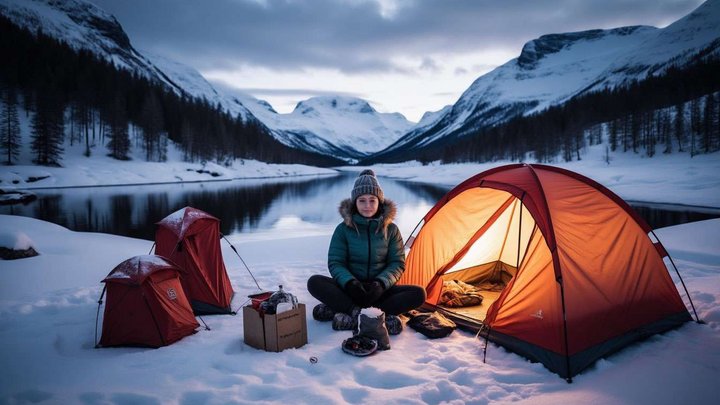
How do you plan winter camping in Norway?
Plan winter camping in Norway with a tent, motorhome or cabin. Check open services, access, sleeping gear, ventilation and a warm backup place.
🧑🦽 Accessible campsites for everyone
🏕️ Where to find accessible accommodation for people with limited mobility and families with children 💙
🛶 Rorbu in the Western Fjords: where to stay by the water
✨ The best places to stay by the fjords: rorbu and campinghytter 🏡
⚡ EV charging at campsites
🗺️ Map and tips for charging electric cars at campsites and rorbu 🔌
🧭 Routes around rorbu: short "loops"
🗺️ Ideas for 60–90-minute loop routes near accommodation in the North ⛰️
🎣 Rorbu and work after fishing
🐟 The best rorbu for anglers: piers, catch storage and evening relaxation 🌊
1 comment
Log in to leave a comment