



When and where can you see the midnight sun in Norway?
Share
Save
In brief: To see the midnight sun in Norway, head north in summer; June suits most destinations. Visit Norway gives seasonal guides of 20 May–22 July for Tromsø and 28 May–14 July for Lofoten. For summer 2027, choose dates within the season rather than at its edges. Clouds and mountains can hide the sun even during the polar day. Source: Visit Norway: midnight sun and seasonal periods, checked 27 October 2026.
What is the polar day, and how does it differ from bright summer nights?
The polar day means the sun does not drop below the horizon during a 24-hour period. The midnight sun is the visible effect of low nighttime sun at northern latitudes in summer. It is caused by the tilt of Earth’s axis, not by the northern lights. Visit Norway: midnight sun and seasonal periods, checked 27 October 2026.
A bright summer night does not in itself establish a polar day. In the south, the sun sets even if it may never become completely dark. The opposite winter season is explained in the polar night guide. Visit Norway: contrasting seasons of light, checked 27 October 2026.
Important
Round-the-clock daylight does not mean the solar disc is visible from every window. Clouds, fog and terrain blocking the horizon can prevent a sighting. Check the open view from your chosen spot and the evening forecast. A practical example: Visit Nordkapp: horizon, clouds and viewing, checked 27 October 2026.
When is the midnight sun visible in different regions?
The table gives Visit Norway’s seasonal guides. They help you choose a period for a summer trip, but are not a separate astronomical calculation for 2027 at your address or mountaintop.
Definitions matter at the season’s edges: Yr distinguishes between the period when the sun’s upper edge is visible and the period when the whole sun is visible. Two calendars can therefore give different dates because they describe different conditions. Yr (MET/NRK): different limits of solar visibility, checked 27 October 2026.
Visit Norway’s approximate seasonal periods for planning
| Destination | Approximate period | How to use it |
|---|---|---|
| Bodø | 4 June–8 July | Choose dates within the period |
| Lofoten | 28 May–14 July | Check the specific location and horizon |
| Vesterålen (Andenes) | 22 May–21 July | Check the evening forecast |
| Tromsø | 20 May–22 July | Choose an unobstructed viewing direction |
| North Cape | 14 May–29 July | Do not assume there will be no fog |
| Svalbard | 20 April–22 August | Plan separately from mainland Norway. Source for every period: Visit Norway: midnight sun and seasonal periods, checked 27 October 2026. |
How do you choose a midnight sun viewing spot?
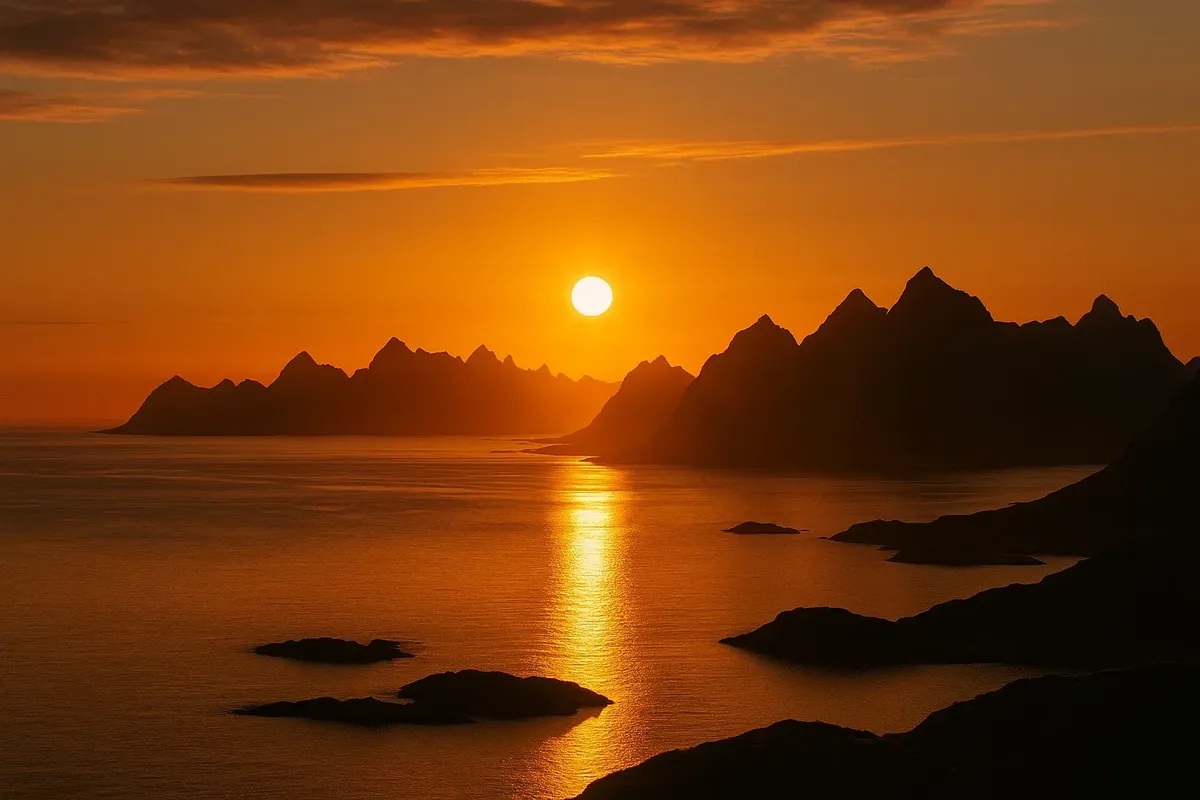
Choose a spot where the low sun will not immediately be hidden by a mountain or buildings. The practical North Cape guide points to an open northern sea horizon. This illustrates how to choose a viewing direction, rather than a rule that you must visit one particular cape. Visit Nordkapp: horizon, clouds and viewing, checked 27 October 2026.
Before leaving, check Yr’s cloud and visibility forecast for the actual spot, not just the nearest large town. With the same seasonal dates, an evening by the sea can look different from one behind a mountain range. Yr: forecast for your chosen location, checked 27 October 2026.
If you are interested in other moments of low light, compare this with the guide to sunrise spots. Do not combine midnight sun and an ordinary sunrise into one guarantee of a “golden hour”.
Example
You are staying in the right region, but a mountain blocks the horizon from your room. Before a late outing, find an accessible spot with an open view and a clear return route. A region’s name does not confirm the view from a particular property.
How do you plan a trip for summer 2027?
Consider June for your initial plans: it falls within the published periods for every mainland destination in the table. This is an inference from the seasonal table, not a forecast of clear weather in June 2027. Do not build the whole route around the first or last day of a listed period. Visit Norway: midnight sun and seasonal periods, checked 27 October 2026.
Choose one base and several possible evenings without a compulsory long transfer. Then arrange transport, check-in and late returns. For the overall trip length, use the guide to Norway in 3, 7 and 14 days.
Shortly before travelling, check solar data for the specific place and day, then the weather for your viewing evening. Yr explains where to find solar data: Yr (MET/NRK): different limits of solar visibility, checked 27 October 2026.
Planning steps
1. Choose a region using the seasonal period. 2. Schedule your holiday within it. 3. Check the horizon at your spot. 4. Arrange travel and a late return. 5. Open the forecast before viewing. 6. Keep the evening free of compulsory distant activities if the weather is poor. Season and forecast: Visit Norway: midnight sun, checked 27 October 2026; Yr: local forecast, checked 27 October 2026.
What can you do if clouds hide the sun?
Cloud does not cancel the polar day, but can hide the solar disc. You can still experience the bright night without insisting on a postcard view of the sun at the sea horizon. Fog at North Cape is explicitly mentioned as a possible obstacle. Visit Nordkapp: horizon, clouds and viewing, checked 27 October 2026.
Do not compensate for a disappointing evening with a long night drive to an unfamiliar mountain spot. DNT advises choosing outings for your ability and the conditions, watching the forecast and changing plans in time. Daylight does not remove cold, fatigue or difficult terrain. DNT: planning for the conditions, checked 27 October 2026.
For photography, first choose a safe place and assess the light, then think about equipment. The solar disc, reflections and clouds offer different subjects; there is no single compulsory camera setting for all conditions.
Common mistake
Looking for northern lights as a substitute for midnight sun on the same bright night. These are different phenomena with different viewing conditions. For a separate northern lights trip, use the northern lights guide. Plan for summer light rather than a guaranteed show.
What should you pack, and how do you plan normal rest?
Pack for the weather and activity, not just the word “summer”. For a late outing, bring suitable footwear, wind protection and an extra warm layer. DNT notes that even short walks can involve cold and poor weather. DNT: planning for the conditions, checked 27 October 2026.
Ask your accommodation about blackout curtains in advance. Bring an eye mask if you prefer using one; prolonged daylight does not have to turn every evening into a night excursion. These are practical comfort measures, not treatment for sleep disorders.
For daytime outings and sun protection, read about sun protection in Norway. Look at the actual forecast conditions rather than expecting constant warmth.
Tip
Plan viewing as a separate, relaxed evening rather than an extension of the hardest day of the trip. Agree on the return and rest beforehand, especially in a group with different energy levels.

Can you walk and travel with children during the polar day?
Yes, but day length does not determine whether an activity is manageable. Choose a walk for everyone’s abilities and keep the option to turn back. A first viewing does not require a mountaintop or a demanding organised tour.
Check museum hours, transport and organised activities separately: 24-hour daylight does not mean 24-hour operation. With children or tired companions, you can watch the bright night near your accommodation and finish earlier.
Base walking decisions on the weather, terrain and group’s energy. DNT advises considering the least able participant and changing plans before anyone is exhausted. DNT: planning for the conditions, checked 27 October 2026.
Evening checklist
Season chosen; viewing spot and horizon understood; forecast checked; return confirmed; clothing suited to the weather; group energy considered; time left for rest. Planning for the conditions: DNT: planning for the conditions, checked 27 October 2026.

Frequently asked questions
No. The polar day concerns the sun’s position, not aurora in the sky. Visit Norway: contrasting seasons of light, checked 27 October 2026.
No. Unlike in the northern destinations, the sun sets in southern Norway. A very bright night is not the same as a polar day. Visit Norway: contrasting seasons of light, checked 27 October 2026.
June falls within the mainland destinations’ seasonal periods in the table. This is not a promise of clear weather or a calculation of exact season boundaries for 2027. Visit Norway: midnight sun and seasonal periods, checked 27 October 2026.
No. It gives regional guides. Check solar data separately for your location and day. Yr (MET/NRK): solar visibility, checked 27 October 2026.
For example, Yr distinguishes between the visible upper edge and the whole sun. Compare matching definitions. Yr (MET/NRK): solar visibility, checked 27 October 2026.
No. They can hide the visible disc. Cloud, fog and the view of the horizon matter locally. Visit Nordkapp: practical viewing, checked 27 October 2026.
No. Choose an accessible spot and a manageable outing. Long daylight does not replace preparation. DNT: planning for the conditions, checked 27 October 2026.
Agree on the effort and return time with everyone in mind. A bright night does not require you to abandon your usual rest plans.
Sources
- Visit Norway: midnight sun and seasonal periods. Checked 27 October 2026.
- Visit Norway: contrasting seasons of light. Checked 27 October 2026.
- Yr (MET/NRK): different limits of solar visibility. Checked 27 October 2026.
- Yr: forecast for your chosen location. Checked 27 October 2026.
- Visit Nordkapp: horizon, clouds and practical viewing. Checked 27 October 2026.
- DNT: planning for the conditions. Checked 27 October 2026.
Author: Ksenia. Updated 27 October 2026.
Share
Save

Read also
Norway in March 2027: skiing, city breaks and Easter planning
Plan a March trip with skiing, city visits and Easter from 25 to 29 March. Check transport, winter conditions and the clock change.

Norway in February 2027: winter holidays, culture and travel plans
Plan February around confirmed dates, winter culture, skiing and city visits. Compare February with March and allow for weather changes.
Norway in January 2027: weather, winter light and a workable trip
Choose Oslo, Bergen or Northern Norway, plan around winter light and transport, and build a January itinerary that can adapt to changing weather.
Polar night in Norway: where to go, when to visit and how to prepare
You can experience polar night in parts of Northern Norway and on Svalbard. Tromsø is a practical option for a first visit, while Longyearbyen has a.
Do you need sunscreen in Norway, even when it feels cool?
Pack sunscreen for Norway and plan around the UV index. Check SPF 30, cloud, snow, children and midnight sun, and find the forecast for your outing.
How many sunny days does Norway have?
Kristiansand has the most sunshine hours and Bergen far fewer: hours by station, what a sunshine hour is and when to come for sun.
1 comment
Log in to leave a comment
Hvilket region (Nord-Norge, Lofoten, Svalbard osv.) anbefaler dere for den mest magiske midnattssol-opplevelsen? 🌌