


Travelling and moving to Norway: visa, D-number, bank account, housing, kindergarten and school
Updated 26.09.2026. Facts checked against Ny i Norge, the Norwegian Tax Administration, Norway's embassies, Visit Norway, the Directorate for Education and Training (Udir), regjeringen.no, Statistics Norway (SSB), the Norwegian Consumer Council and the Norwegian Food Safety Authority.
Short answer: From the EU/EEA you travel to Norway with a valid passport or national ID card. Many other countries can stay in Schengen for 90 days within 180 days without a visa; others must apply for a Schengen visa (fee EUR 90). To live and work in Norway you need registration or a residence permit, a Norwegian ID number (national identity number or D-number), a tax deduction card and a bank account – and then BankID.
Key facts
| Question | Answer | Source, checked |
|---|---|---|
| Visa for EU/EEA citizens | No – a valid passport or national ID card is enough | Visit Norway, 26.09.2026 |
| Visa-free stay | Up to 90 days within 180 days (including the USA, UK, Canada, Australia) | Visit Norway, 26.09.2026 |
| Schengen visa | Fee EUR 90 (children under 6 free); processing normally up to 15 days | Norway's embassies, 26.09.2026 |
| Travel insurance for a visa | At least EUR 30 000, including repatriation | Norway's embassies, 26.09.2026 |
| EES and ETIAS | EES is fully operational; ETIAS expected in the last quarter of 2026, date not confirmed | Visit Norway, 26.09.2026 |
| National identity number | If you have a right of residence and will live in Norway for six months or more | Ny i Norge, 26.09.2026 |
| Rental deposit | Max six months' rent, in a separate account in the tenant's name | Norwegian Consumer Council, 26.09.2026 |
| Rent, 2 rooms | NOK 11 790 on average in Norway; NOK 15 260 in Oslo and Bærum (2025) | SSB, 26.09.2026 |
| Kindergarten, maximum price | NOK 1 200 per month from 01.08.2025 (NOK 700 in the least central municipalities) | Udir, 26.09.2026 |
| School | Free public school; starts in August of the year the child turns 6 | Ny i Norge, 26.09.2026 |
| Studies | Students from outside the EU/EEA and Switzerland normally pay tuition fees; funds required NOK 170 368 per year (2026–2027) | Study in Norway, 26.09.2026 |
What applies to you?
- Tourist: see visa, passport and insurance and EES and ETIAS.
- You are moving to Norway from the EU/EEA: see registration, ID number, tax deduction card, bank account and BankID.
- You are moving from outside the EU/EEA: you need a residence permit before you start working.
- You have children: see kindergarten and school and SFO.
- You are going to study: see studies and tuition fees.
- You are bringing a dog or cat: see pets.
Do I need a visa for Norway?
Norway is part of Schengen. Citizens of the EU/EEA and the Nordic countries do not need a visa and can travel with a valid passport or national ID card. If you come from a country with visa-free access to Schengen – including the USA, the UK, Canada, Australia, New Zealand and Japan – you can stay in Norway for up to 90 days within any 180-day period without a visa (Visit Norway, checked 26.09.2026).
Others must apply for a Schengen visa before travelling. The fee is EUR 90; children under six do not pay. Processing normally takes up to 15 calendar days after the embassy has received the application. You apply to the embassy or consulate of the country that is the main destination of your trip (Norway's embassies, checked 26.09.2026). Addresses of embassies and consulates in Oslo are in our directory.

Passport and travel insurance
If you apply for a visa, your passport must be valid for at least three months after you leave Schengen, and your travel insurance must cover at least EUR 30 000, including repatriation for medical reasons (Norway's embassies). Even without a visa requirement, travel insurance is a good idea: read about healthcare, the EHIC and costs in our guide to healthcare in Norway.
EES and ETIAS: new rules at the border
The Entry/Exit System (EES) is now fully operational at all border crossings in Norway and Schengen. It applies to travellers who are not citizens of the EU, Iceland, Liechtenstein, Norway or Switzerland and who come for a short stay. The first time you enter, your identity, travel document, facial image and fingerprints are registered.
ETIAS is a travel authorisation for visa-exempt travellers. It is expected to start in the last quarter of 2026, but the date has not been confirmed. ETIAS will be valid for three years or until your passport expires (Visit Norway, checked 26.09.2026).
Moving to Norway: registration or residence permit
- EU/EEA citizen: if you will work in Norway for more than three months, you must register. Registration covers work, studies and stays on your own funds.
- From outside the EU/EEA: you need a residence permit to work in Norway or to stay here for more than 90 days.
Source: Ny i Norge, checked 26.09.2026. Applications and requirements are on the UDI website. More on the rules for work and internships: entry and residence for work.
National identity number or D-number?
You can get a Norwegian national identity number if you have a right of residence and will live in Norway for six months or more. If you are here temporarily, you usually get a D-number (Ny i Norge).
You cannot apply for a D-number yourself. An employer or a public authority requests it when they need a Norwegian ID number for your case, and the Tax Administration checks your identity. You need a certified copy of your passport or ID card – in colour, both sides, and not older than three months (Norwegian Tax Administration, checked 26.09.2026).
Tax deduction card
Most people who work in Norway must have a tax deduction card and a Norwegian ID number (Norwegian Tax Administration, checked 26.09.2026). The card tells your employer how much tax to deduct. How much you keep after tax is calculated in our guide to salary and tax.
Can I open a bank account in Norway?
To open a bank account, you must be resident in Norway, have valid proof of identity (passport or national ID card) and a Norwegian ID number – a national identity number or D-number (Ny i Norge). Basic banking services – an account, a bank card and online banking – are in principle available to everyone living in Norway, regardless of citizenship (Finance Norway).
Banks must follow the Money Laundering Act. You will therefore have to state your home address and explain what you will use the account for and where the money comes from. Banks are in our directory – see your city.
BankID for foreigners
You get BankID through your bank once you are a customer. You must be at least 15, and some banks do not issue BankID to people under 18 (Finance Norway). You activate the BankID app by scanning your passport or national ID card – foreign ID documents can be used too (bankid.no, checked 26.09.2026). With an electronic ID you use public services and online banking and book doctor's appointments (Ny i Norge).
Renting a home: prices and deposit
According to Statistics Norway's rental market survey for 2025, the average monthly rent for a two-room flat was NOK 11 790 in Norway and NOK 15 260 in Oslo and Bærum (published 22.12.2025).
The deposit cannot be more than six times the monthly rent. It must be held in a separate bank account in the tenant's name, and neither party can withdraw the money alone. The landlord pays for setting up the account, and the interest goes to the tenant (Norwegian Consumer Council, checked 26.09.2026).
Read more: long-term rental in Norway and rental agreement and deposit.

Kindergarten: right to a place and price
Children who turn one no later than the end of November in the year of application have the right to a kindergarten place (regjeringen.no). You apply through the municipality where you live.
- Maximum price: NOK 1 200 per month from 1 August 2025; NOK 700 in municipalities in centrality zones 5–6. In Finnmark and Nord-Troms (the action zone) kindergarten is free.
- Siblings: at least a 30 % reduction for the second child; from the third child the place is free.
- Low income: you pay no more than 6 % of household income per child. Children aged 2–5 get 20 hours of free core time a week if income is below the limit (NOK 692 465 from 1 August 2026).
Source: Udir, updated 26.05.2026. Kindergartens in our directory – see your city.
School and SFO
Children start school in August of the year they turn six and attend primary and lower secondary school for ten years. Public primary and lower secondary school is free, and all children aged 6–16 have the right and obligation to attend. The school year runs from mid-August to mid-June; holidays and days off are in the school calendar of the municipality where you live (Ny i Norge).
All municipalities must offer SFO (in Oslo: AKS) for years 1–4. Pupils in years 1–3 get 12 hours of free SFO a week, and parental payment for years 1–4 may not exceed 6 % of household income (regjeringen.no, updated 14.11.2025).
School calendar in Oslo 2026–2027: holidays and days off
| What | When |
|---|---|
| First school day | Monday 17 August 2026 |
| Autumn holiday | 28 September–2 October 2026 |
| Christmas holiday | 21 December 2026–1 January 2027 |
| Winter holiday | 22–26 February 2027 |
| Easter holiday | 22–30 March 2027 |
| Other days off | 6 May (Ascension Day), 7 May and 17 May 2027 (Constitution Day and Whit Monday) |
| Last school day | Friday 18 June 2027 |
Planning days (planleggingsdager) fall within the holidays and days off. AKS (after-school care in Oslo) is open during school holidays but closed all of July, on public holidays, Christmas Eve and New Year's Eve. Other municipalities have their own school calendar – check the municipality's website. Source: Oslo municipality, school calendar 2026/2027 (checked 27.09.2026).
Studies: is it free to study in Norway?
For students from Norway, the EU/EEA and Switzerland, public universities and university colleges are tuition-free. Degree students from outside the EU/EEA and Switzerland must normally pay tuition fees. Exchange students and doctoral candidates are usually exempt. Everyone pays a semester fee of around NOK 1 000 to the student welfare organisation.
If you apply for a study permit, you must show that you can support yourself: at least NOK 170 368 per year, or NOK 15 488 per month, for the 2026–2027 academic year (Study in Norway, checked 26.09.2026).
Moving or travelling to Norway with a dog or cat
Requirements for a private trip with a dog from the EU/EEA (Norwegian Food Safety Authority, updated 03.02.2026):
- identification with a microchip to ISO standard 11784;
- rabies vaccine: the dog must be at least 12 weeks old, the chip is inserted before the vaccine, and after the first vaccination there is a 21-day waiting period;
- EU pet passport from an authorised vet in the EU/EEA;
- treatment against the fox tapeworm 24–120 hours before the dog arrives in Norway – not needed for dogs coming directly from Finland, Malta or Ireland;
- use the red zone at customs and show the animal and its documents. Directly from Sweden you may use the green zone if all requirements are met.
What it costs and how to save: moving to Norway with a pet.
Banks, kindergartens, schools and universities in your city
| City | Banks | Kindergartens | Schools | Universities and colleges |
|---|---|---|---|---|
| Oslo | Banks | Kindergartens | Schools | Universities and colleges |
| Bergen | Banks | Kindergartens | Schools | Universities and colleges |
| Trondheim | Banks | Kindergartens | Schools | Universities and colleges |
| Stavanger | Banks | Kindergartens | Schools | Universities and colleges |
| Tromsø | Banks | Kindergartens | Schools | Universities and colleges |
| Kristiansand | Banks | Kindergartens | Schools | Universities and colleges |
Embassies and consulates: Oslo.
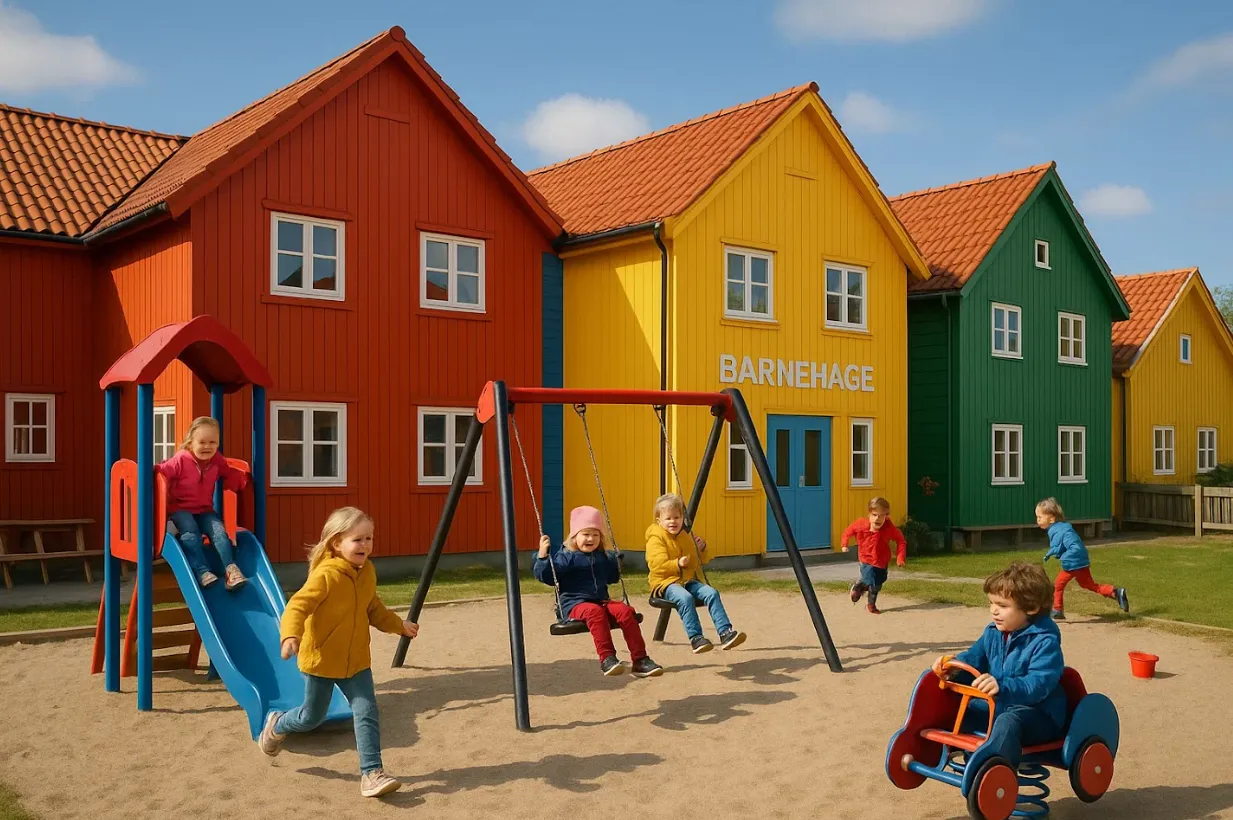
Photos: documents, housing, kindergarten and school







People also ask
- Do I need a visa for Norway?
- Do I need a visa for Norway from the USA or the UK?
- How much does a Schengen visa cost?
- How long must my passport be valid?
- How much must travel insurance cover?
- What is EES?
- When does ETIAS start?
- Do EU citizens have to register in Norway?
- Do I need a residence permit to work in Norway?
- How do I get a D-number?
- What is the difference between a national identity number and a D-number?
- Do I need a tax deduction card?
- Can foreigners open a bank account in Norway?
- What do I need to open a bank account?
- How do foreigners get BankID?
- How much is a deposit on a flat?
- How much does it cost to rent in Oslo?
- How much does kindergarten cost?
- When does a child have the right to a kindergarten place?
- When do children start school in Norway?
- Is SFO free?
- Is it free to study in Norway?
- How much money must students document?
- What does a dog need to travel to Norway?
- When are the school holidays in Oslo 2026–2027?
- When is SFO/AKS closed in summer?
Frequently asked questions about travelling and moving to Norway
Not from the EU/EEA or from countries with visa-free access to Schengen, such as the USA, the UK, Canada and Australia – then you can stay up to 90 days within 180 days. Others must apply for a Schengen visa.
A Schengen visa costs EUR 90. Children under six do not pay. Processing normally takes up to 15 calendar days.
If you apply for a visa, your passport must be valid for at least three months after you leave Schengen.
EES registers the facial image and fingerprints of travellers from outside the EU/EEA at their first entry and is fully operational. ETIAS is a travel authorisation for visa-exempt travellers expected in the last quarter of 2026.
Yes, if you will work in Norway for more than three months.
You do not apply yourself: your employer or a public authority requests a D-number for you, and the Tax Administration checks your identity.
Usually not. You must be resident in Norway and have a valid passport or ID card and a national identity number or D-number.
Through your bank once you are a customer. You must be at least 15. The app is activated by scanning your passport – foreign passports can be used too.
At most six months' rent. The money must be held in a separate deposit account in the tenant's name.
The maximum price is NOK 1 200 per month from 1 August 2025, and NOK 700 in the least central municipalities. There are sibling discounts and reduced prices for low incomes.
In August of the year the child turns six. Public primary school is free.
Yes for students from the EU/EEA and Switzerland at public institutions. Degree students from other countries normally pay tuition fees.
A microchip, rabies vaccine, EU pet passport and usually tapeworm treatment 24–120 hours before entry.
Monday 28 September–Friday 2 October 2026. The winter holiday is 22–26 February 2027 (Oslo municipality, school calendar 2026/2027).
AKS is open during school holidays but closed all of July, on public holidays, Christmas Eve and New Year's Eve (Oslo municipality).
Sources
All links checked 26.09.2026.
- Visit Norway: do I need a visa?
- Visit Norway: EES and ETIAS
- Norway's embassies: visitor's visa
- Ny i Norge: residence permit
- Ny i Norge: checklist after arrival
- Norwegian Tax Administration: D-number
- Norwegian Tax Administration: tax deduction cards
- Finance Norway: how to become a bank customer in Norway
- BankID: foreign passport or ID document
- Statistics Norway: rental market survey
- Norwegian Consumer Council: deposit
- Government: kindergarten
- Udir: parental payment in kindergarten
- Ny i Norge: school in Norway
- Government: after-school programme (SFO)
- Study in Norway: cost and requirements
- Norwegian Food Safety Authority: travelling to Norway with a dog from the EU/EEA
- Oslo municipality: school calendar – holidays and days off (Norwegian)
Readers' experiences
How long did it take you to get a D-number, a bank account or BankID? Did you get a kindergarten place where you wanted? Tell us in the comments at the bottom of the page. We use your experiences when we update this guide.




0 comments
Log in to leave a comment